
The Indian rupee, swaying through multiple headwinds, tiding over global trade disruptions and massive foreign fund outlfows, is unlikely to arrest its descent until tariff impact overhangs, notwithstanding robust domestic macroeconomic tailwinds. The Reserve Bank of India (RBI), which sees the rupee's depreciation as a silver bullet to offset the tariff shock, expects the currency to find its stable course once India reaches a trade deal with its largest trading partner, the US.

India's first maritime lender, state-owned Sagarmala Finance Corporation Ltd (SMFCL) hit the ground running with a Rs 4,300 crore disbursement announcement last Tuesday, within months of being registered as a non-banking financial company (NBFC) in June 2025.

Several companies across sectors like finance, healthcare, wellness, retail technology, and asset management are bracing up to hit the D-street. With an unprecedented 1.7 lakh crore raised in 2025, the momentum is likely to sustain in 2026.

'Global uncertainty is something which definitely occupies the minds of officials when we are preparing for the Budget.'

Worries about global politics and trade are pulling the Nifty 50 down. Experts say the market could drop further low.

'We believe the truth is in the middle, and that India is at an important crossroads.'

The Indian government has expressed its disagreement with the IMF staff's 'baseline' assumption that the 50 per cent US tariffs on its goods exports 'would remain in place indefinitely', based on which the staff pegged the country's GDP growth at 6.6 per cent this year, and pared its 2026-27 projection by 20 basis points to 6.2 per cent.
'Maybe he was wrong, but they believed he genuinely meant what he said.'

India, the world's fourth largest economy, is set to maintain the 'goldilocks' phase with tailwinds of good growth, low inflation and robust banking performance as well as reform initiatives poised to sustain the economic pace witnessed during 2025.

From the Sensex pack, Reliance Industries, Bajaj Finserv, HDFC Bank, Adani Ports, Maruti Suzuki India, Axis Bank, Hindustan Unilever, Sun Pharmaceuticals and Asian Paints were among the laggards. Reliance Industries fell the most by 2.38 per cent to close at Rs 1,171.10 apiece.

Gold has emerged as the most stable asset during episodes of geopolitical stress, and crude oil has been more sensitive than others when it comes to regional conflicts and sanctions, according to a report in the Reserve Bank of India's (RBI's) monthly bulletin. Silver and the United States Treasury have showed moderate reactions.

Arundhati Bhattacharya is a strong contender for chairperson post, after Pratip Chaudhuri retires in September.

Three laws passed in Parliament could boost central revenues, reshape GST cess flows, shift MGNREGA costs to states and create new budget headroom ahead of the 2026-2027 Union Budget, points out A K Bhattacharya.

Infrastructure bonds, which were relied upon the most in 2024-25 (FY25) by commercial banks to raise funds through the domestic debt capital market amid lagging deposit growth, seem to have lost their sheen in FY26. So far in FY26, no bank has tapped the domestic debt capital market to raise funds via infra bonds, and the expectation is that the amount raised through this route will be significantly lower than that last year, unless credit demand picks up.

Home purchase affordability has improved in the first half of calendar year (CY) 2025, after the RBI reduced the repo rate by 100 basis points (bps), according to real estate consultancy Knight Frank India.

The reduction in the goods and services tax (GST) rates has increased the momentum in India's economic activity both on the supply and demand sides, while robust agricultural activity - reflected in the strong onset of rabi sowing and adequate reservoir levels - has reinforced the outlook for food supply and rural incomes, the finance ministry said on Thursday.
State Bank of India (SBI), the largest lender in the country, has launched a share sale to institutional investors to raise upto Rs 25,000 crore, the biggest qualified institutional placement (QIP) so far by an Indian firm, and has set a floor price of Rs 811.05, which is at a 2.5 per cent discount on Wednesday's closing price.

HCL Tech, State Bank of India, Infosys, Tech Mahindra, Tata Consultancy Services, Bajaj Finserv, Larsen & Toubro, Mahindra & Mahindra and Titan were also among the losers in the Sensex pack. Eternal, Hindustan Unilever, Asian Paints, ITC, Tata Motors and NTPC were among the gainers.
From the 30 Sensex pack, Mahindra & Mahindra, State Bank of India, Power Grid, Tata Steel, IndusInd Bank, Tata Motors, Larsen & Toubro, NTPC, Bajaj Finance and Reliance were among the biggest laggards.
Mergers to create at most six state banks

Brookfield Asset Management will invest $1 billion to develop Asia's largest global capability centre (GCC) in Mumbai's Powai, the New York-based global alternative asset manager said in a statement on Friday. The infrastructure arm of Canada's investment firm will develop the campus across 6 acres with 2 million square feet that can be let out.

Canadian firm Manulife and Mahindra & Mahindra (M&M), an Indian automaker with interests in financial services, have signed an agreement to form a 50:50 life insurance joint venture (JV) with a total capital commitment of up to Rs 3,600 crore each totalling Rs 7,200 crore.

This exercise allows investors to realign their portfolios with changing market conditions and evolving personal objectives.

Importers are rushing to hedge their dollar positions amid the sharp depreciation of the rupee against the American currency and expectations of further volatility even as exporters are holding off after suffering mark-to-market (MTM) losses on earlier hedges.
From the 30-share Sensex pack, Infosys, ICICI Bank, Kotak Mahindra Bank, Mahindra & Mahindra, State Bank of India, HCL Technologies, Axis Bank, NTPC and HDFC Bank were among the laggards. In contrast, Maruti, IndusInd Bank, Adani Ports, ITC and UltraTech Cement defied broader market trends and ended in positive territory.

Amid US-China trade tensions and economic vulnerabilities, India must seize the 'China +1' opportunity, deepen reforms, secure FTAs, and globalise its firms for long-term growth, suggests Ajay Shah.

ITC, State Bank of India, HCL Technologies and IndusInd Bank were the other big laggards. NTPC, UltraTech Cement, HDFC Bank and Mahindra & Mahindra were among the gainers.

Infrastructure bond issuances by commercial banks in the current financial year (FY25) are likely to surpass Rs 1 trillion, almost double that of FY24, market participants said. So far this financial year, banks have raised Rs 74,256 crore via infra bonds. In FY24, the total issuances stood at around Rs 51,081 crore.

Deloitte India on Thursday projected India's economy to grow 6.7-6.9 per cent in the current fiscal amid buoyant demand and policy reforms. Indian economy grew 7.8 per cent in the April-June quarter of current fiscal.

Reserve Bank of India (RBI) Governor Sanjay Malhotra, and Deputy Governors Poonam Gupta, T Rabi Sankar, Swaminathan J, and S C Murmu on Friday addressed issues during the post-policy media interaction.

Finance Minister Nirmala Sitharaman on Thursday asked India Inc to take advantage of the policies and reforms undertaken by the government and no longer hesitate to invest more and expand capacities. Sitharaman also asked the industry to partner with the government for skilling the youth and also to engage with the government throughout the year, and not just before the Budget.

Benchmark BSE Sensex declined for the fourth day in a row on Wednesday due to selling in financial and banking shares and the government's move to hike securities transaction tax and short term capital gains tax. The 30-share BSE Sensex declined 280.16 points or 0.35 per cent to settle at 80,148.88 with 19 of its components closing lower and 11 with gains. During the day, it tumbled 678.53 points or 0.84 per cent to 79,750.51.
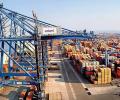
State-owned Life Insurance Corporation (LIC) on Thursday entirely subscribed to the Rs 5,000 crore bond issue of Adani Ports and Special Economic Zone (APSEZ) at a coupon rate of 7.75 per cent, said sources privy to the development.

'Listing of scaled Indian subsidiaries of multinational corporations as well as of Indian conglomerates continues to remain a key theme for IPOs in India.'

'Calibrated depreciation will help rebalance external fundamentals, offset some of the tariff differentials with competitors, improve the competitiveness of domestic substitutes vis-a-vis Chinese imports, and contribute to the easing of financial conditions at a time when the inflation rate is unusually low,' explains Sajjid Z Chinoy, head of Asia Economics at JP Morgan.

Among Sensex firms, Bharat Electronics rose the most by 4.26 per cent. HCL Tech gained 2.57 per cent, Bajaj Finance by 2.19 per cent, TCS by 1.99 per cent, Tech Mahindra by 1.88 per cent and Infosys by 1.85 per cent. Gains in Axis Bank and State Bank of India also supported the rally. However, Mahindra & Mahindra emerged as the biggest loser, falling by 2.47 per cent. Maruti dropped 1.53 per cent and Tata Motors by nearly 1 per cent due to profit-taking. UltraTech, Eternal and Power Grid were also among the laggards.

Who else will take on the might of Microsoft, Google, and Amazon if not the Adanis, Ambanis, Birlas, or Tatas?, asks R Jagannathan.

'What we need to watch is how Saudi Arabia's financial assistance will be used by Pakistan. If the funds go to build their military hardware and operations, it should worry us.'

Let's work flat out and create a policy framework that fosters the growth of Indian non-family business VC and private equity firms. This will allow our Indian startups' dreams to flourish, explains Ajit Balakrishnan.

'This is an area where good lending can happen, and that is one of the priorities for the next quarter.'
 © 2026 Rediff.com - Advertise with us - Disclaimer - Privacy Policy - Sitemap - Feedback - About us - Terms of use - Grievances